How Tax Brackets Actually Work
Why a raise can never leave you with less money — and what your “tax bracket” really means.
Your uncle tells you not to accept a raise because it’ll mean paying more taxes, leaving you with less overall income. While you quietly sigh in relief because the raise would come with way too many added responsibilities, you start to wonder whether it’s actually true. Unfortunately for your excuse (and fortunately for your bank account), it isn’t true. It’s a financial myth that’s even more misleading than politicians.
The Canadian tax system is a progressive tax system, which simply means your income gets taxed in individual brackets, not all at one set rate. Only the dollars inside each bracket get taxed at that bracket’s rate.
So, what is a tax bracket?
A tax bracket is just a range of income with a set tax rate attached to it. That’s it. Picture your income sliced into layers (if you’re a foodie, picture a lasagna), where each layer is taxed at its own rate. The higher the layer, the higher the rate.
Here’s the part that trips people up: everyone pays the same rate on the same layer. Your first $50,000 is taxed at that first-layer rate whether you earn $50,000 a year or $500,000 a year. A higher earner doesn’t pay more on that layer – they simply have more layers stacked above it. Nobody’s income gets reclassified. It just gets sliced.
Your marginal tax rate is the rate you pay on the next dollar of income you earn. It’s the rate that applies to the extra income from a raise – not to your entire income.
The raise that “costs” you money
Numbers make this obvious, so let’s walk through a made-up scenario with clean, round figures. (Note: These aren’t real Canadian tax rates – they’re simplified to keep the math readable). Real Canadian rates look a lot messier because there are both federal and provincial brackets that overlap each other. We won’t be dealing with that here.
Say your income is currently $50,000. The first tax bracket is 20% tax on the first $50,000 of income, and income between $50,000 and $80,000 is within the second bracket taxed at 30%. At your current salary, you’re paying $10,000 ($50,000 × 20%) in taxes every year. Already too much. This leaves you with $40,000 in take-home pay.
Your boss pulls you into their office, and your heart starts racing as you brace to be let go. Instead, they cheerfully offer you a $5,000 raise for your outstanding performance (which, of course, ChatGPT did 70% of). This bumps your income into the second tax bracket, where the rate is 30%.
You now assume you’ll pay 30% on your entire income, which is $16,500 ($55,000 × 30%) in taxes – leaving you with take-home pay of $38,500. That’s $1,500 less than the $40,000 you were taking home at a $50k salary. You start to panic: more responsibility, less money. Wonderful. This is the financial myth (and the overthinking) at its finest.
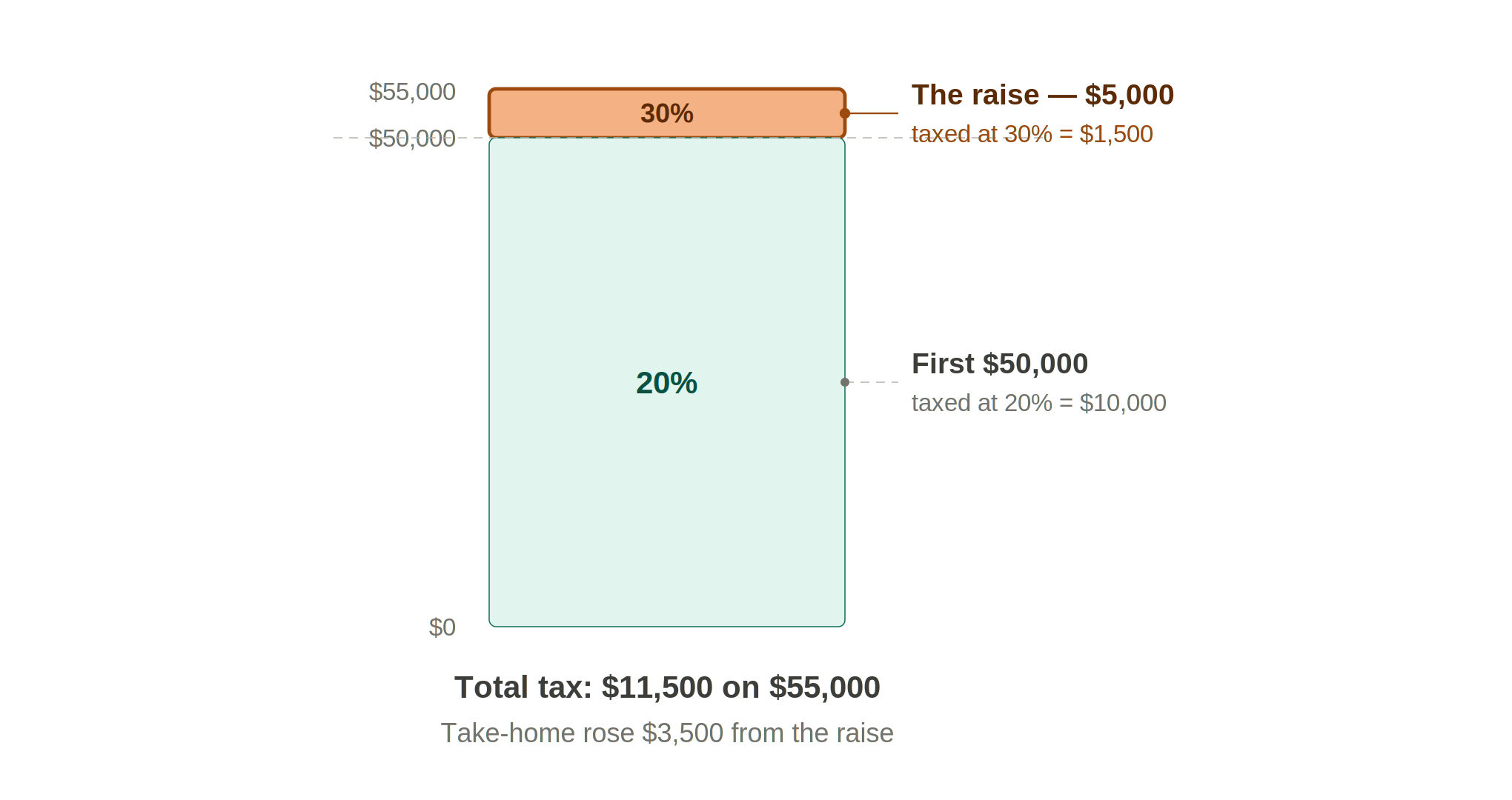
Now, let’s look at reality. Your actual taxes would be $11,500, not $16,500. The first $50,000 you earn is still taxed at 20%, exactly as it was before – that’s $10,000. Only the $5,000 the raise added sits in the second bracket and gets taxed at 30%, which is $1,500. Add them together and you get $11,500, leaving you with take-home pay of $43,500 – $3,500 more than before. You can cheerfully accept the raise without being at all sure you can handle the extra responsibilities. Below is a chart to help visualize it.
Marginal vs. average – the number you actually pay
From the scenario above, your marginal tax rate is 30%, because that’s the rate applied to the next dollar you earn. It only touches the top layer of your income – the $5,000 sitting between $50,000 and $55,000.
Your average tax rate is your total tax divided by your total income: $11,500 ÷ $55,000, which is roughly21%. That’s the rate you actually pay across every dollar you earn. Your average rate is always going to be lower than your marginal rate. The only exception is if every dollar you earn sits in that first bracket – then they’re identical.
Once again, your marginal rate describes one thin slice – the slice at the top. Your average rate describes the whole lasagna.
So, should you fear a raise?
The short answer – no. More gross income will always mean more take-home pay. The idea that you’ve been moved into a “higher bracket” is a misread of the word bracket. Only the additional income is taxed at the higher rate, never your entire income. The number that scares people is the 30%. The number they actually pay is the 21%. The fear is aimed at the wrong figure.
If the added responsibilities are something ChatGPT can’t handle – then yes, fear the raise. The only good that can come from it is that you might get laid off and have no income, and therefore pay no taxes at all. That’s definitely a win (to some extent).
One honest caveat before you go. Tax brackets can’t drag you backwards, but there is a separate part of the system that occasionally can: income-tested benefits. Programs like the Canada Child Benefit and the GST/HST credit shrink as your income rises, so a raise can sometimes shave a little off what you receive from those benefits. That’s a benefits clawback, not a tax bracket, which is a different mechanism and a subject for another article. It doesn’t change the rule here: the higher rate never reaches down and re-taxes the dollars below it.
So take the raise. Take the overtime, the bonus, or the extra shift. You’ll keep less of that top slice than you might like – but you always end up keeping more.
This article is for general educational purposes only and is not financial or tax advice. Everyone’s tax situation is different, so please consult a qualified accountant or tax professional before making decisions based on your own circumstances.
